Mirrors That Make Rooms Feel Bigger and Brighter: A Simple Styling Guide
Mirrors are the cheapest square-footage hack in home decor. The right mirror bounces light around the room, reflects the parts you love, and tricks the eye into seeing more space — all without moving a single wall. But mirror placement is a skill: hung wrong, a mirror just reflects a ceiling fan. Here’s how to do it right.
Why Mirrors Work
A mirror doubles whatever it faces. Point it at a window and you’ve effectively added a second window. Point it at a blank wall and you’ve added a blank wall. The whole game is choosing what the mirror sees. Before you hang anything, stand in the room and look at what’s worth doubling: light, plants, art, a pretty view.
Opposite the Window: The Classic Move
Hanging a mirror directly across from a window is the fastest way to brighten a dark room. Light bounces straight back in, and you get the view twice. This works beautifully in living rooms, dining rooms, and north-facing rooms that never quite wake up.
Beside the Window: The Safe Alternative
If the mirror can’t sit opposite, hang it on the wall adjacent to the window, close to the window’s edge. You still catch reflected light without the risk of a mirror glaring back at you from across the room. This placement flatters entryways and hallways too.
The Round Mirror Rule
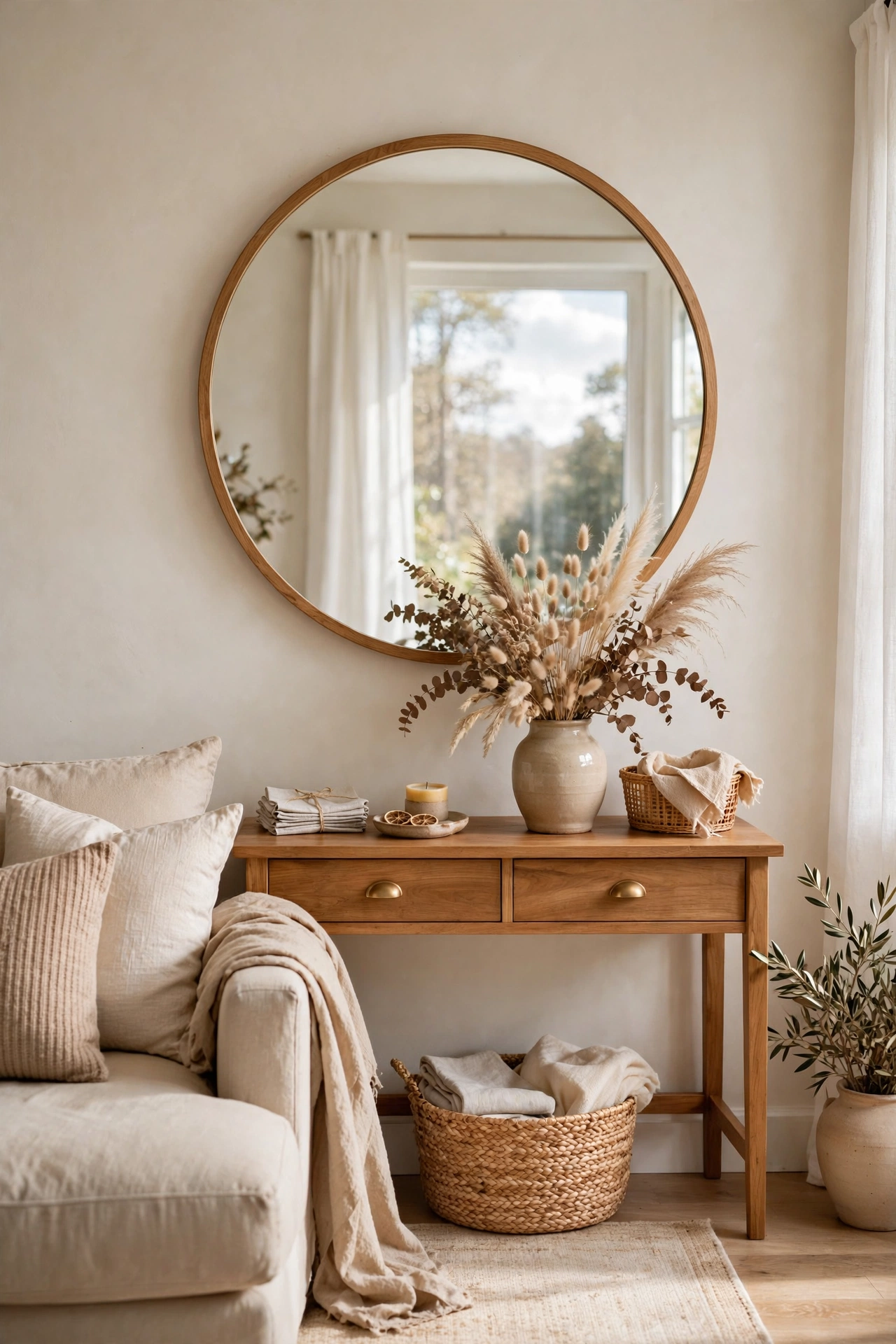
Round mirrors soften rooms full of rectangles — sofas, TVs, tables, shelves. One large round mirror (24–36 inches) above a console, dresser, or mantel is the most forgiving, Pinterest-proven placement there is. It needs nothing else; the shape does the work.
Go Big in Small Rooms
Small room, big mirror. A floor-length mirror leaning against the wall visually doubles the room’s depth, and leaning avoids putting holes in the wall. In bedrooms, a leaning mirror also replaces the missing “getting dressed” mirror — two jobs, one purchase.
Mirrors in the Dining Room
A mirror near the dining table makes dinner feel more festive — candlelight multiplies. Hang it where seated guests can see something pleasant reflected (a plant, a window, art) rather than the kitchen counter mid-cleanup.
What Not to Reflect
Check the reflection from seating eye level, not standing. Mirrors that face clutter, open closets, or the least-loved corner of the room just broadcast the problem. Angle or relocate until the mirror shows something you’d photograph.
Frames Matter
The frame is the decor; the glass is the function. A black frame reads modern, brass reads warm and classic, a wood frame reads cozy, and a frameless mirror disappears entirely. Match the frame to the room’s hardware — faucets, knobs, light fixtures — for a pulled-together feel.
Grouping Small Mirrors
A cluster of three to five small mirrors in mixed shapes works like a gallery wall and fits narrow spots like hallways and stairwells. Keep spacing tight and even (2–3 inches), and vary sizes while repeating one frame finish for cohesion.
The Takeaway
Think of a mirror as a camera you control: it shows the room whatever you point it at. Aim it at light and beauty, size it boldly, and pick a frame that belongs in the room. Done well, a $40 mirror does the work of a skylight.